Japan Cup History
Mairzy Doates
Japan Cup History Mairzy Doates: How a 1981 Experiment Became One of the World's Great Races
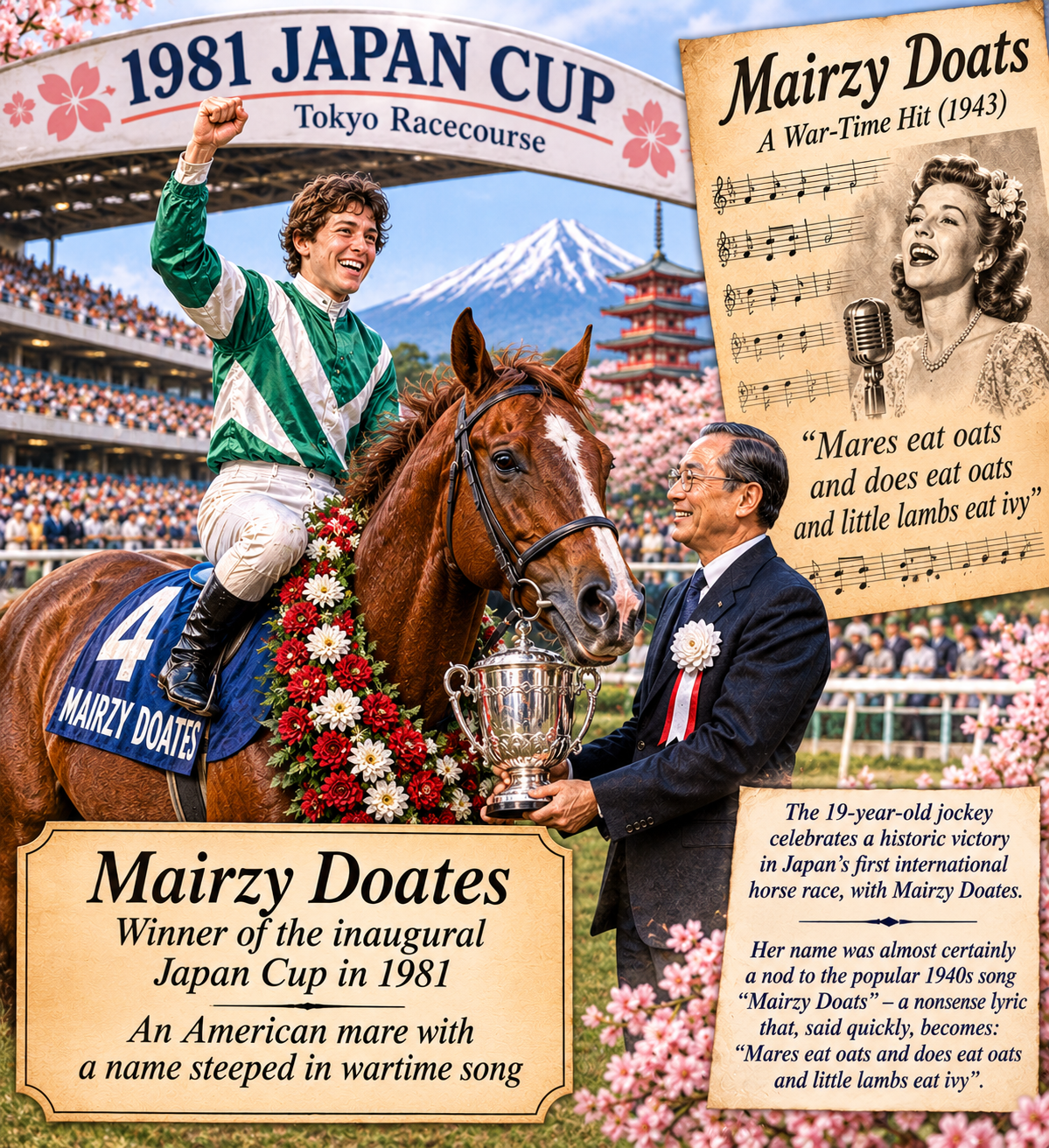 Mairzy Doates wins the inaugural Japan Cup
In a nutshell: The Japan Cup began in 1981 as Japan's first proper international race, a 2400m test of how the home side measured up against the world. The visitors won the first one, with an American mare called Mairzy Doates, and the shock helped change Japanese breeding for good. Four decades on, Japan's horses are winning all over the globe and the Japan Cup is a fixture on every serious racing fan's calendar.
Hardly anybody planned for Mairzy Doates to be remembered. She wasn't the headline name in the field, she cribbed, and she had a slightly dodgy front-leg action. She also won the first Japan Cup, and everything that followed in Japanese racing owes her a quiet thank you.
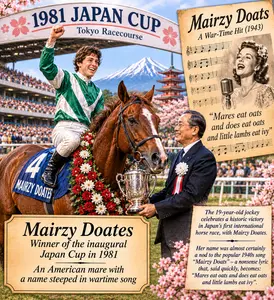
Even the name has a bit of history to it. "Mairzy Doats" was a nonsense novelty song that became a hit in America during the Second World War, and it sounds like gibberish until you say it quickly and realise it is "mares eat oats and does eat oats and little lambs eat ivy".
The mare's name is almost certainly a nod to it, which seems fitting for a horse who spent her career confounding the form.
A galactic line-up, in theory
By 1981 Japan had decided it wanted to see where its racing stood in the world. The idea was to open a race to international visitors for the first time and invite a high-class cast to Tokyo. It must have seemed a bit of a leap into the unknown to plenty of people at the time.
Mairzy Doates wasn't exactly the first name on anyone's list. She was a solid Grade 2 and Grade 3 winner on both American coasts, but this was a field with serious pedigree.
Seven overseas runners turned up, six from the USA and Canada plus, rather wonderfully, the Indian superstar Own Opinion. The home side was led by the Tenno Sho winner Hoyo Boy.
Her owner, the art dealer Arno Schefler, accepted the invitation. Her trainer, John Fulton, was given the job of getting her there. Fulton had taken over from the legendary Horatio Luro when Schefler moved the mare from her Miami base to California.
Ice, ankles and a five-furlong gallop
Fulton flew out about 13 days before the race, and the trip didn't go to plan. Mairzy Doates arrived with some feeling in her ankles, which he put down to the flight. His preparation plan went out the window.
Instead he stood her in ice morning and afternoon to bring the swelling down. He then sent her a five-furlong breeze three days before the race, and she worked spectacularly. Not bad for a five-year-old mare who had already run a dozen times that year, including a narrow second in the Long Island Handicap at Aqueduct a month earlier.
Fulton also noted that Japan didn't allow medication, even then. He was happy with that. "It was quite an experience," he says now, with a laugh, forty-five years on.
A 19-year-old and a plan that didn't exist
The night before, Schefler wanted to sit down and plan where the mare would sit in the race. Fulton knew it wasn't worth the effort. Mairzy Doates ran her race the way she wanted to, closer if the pace was slow and further back if it was fast, and nobody had a clue how a field from all over the world was going to run.
They decided to leave it to the rider, a 19-year-old Cash Asmussen. The Japan Racing Association had paid for two people to travel with the horse, and Asmussen brought his mother along.
What happened next was a proper coming-of-age ride. Asmussen made up around 20 lengths from the turn into the straight, wound his way through traffic and took the lead by a length close to the line. The North Americans filled the first four places, with Frost King, The Very One and P'Tite Tete behind her. The time was a big new track record for the mile and a half.
Fulton remembers that the great jockey Bill Shoemaker, a friend who rode plenty of horses for him, praised the young rider's patience. There is a bit of an uphill climb in the Tokyo straight, too, and that suited a mare who could really stay. She was by Nodouble out of a TV Lark mare, so there was plenty of stamina in the pedigree.
It wasn't long afterwards that Asmussen signed a contract with Francois Boutin and moved to France. He would later ride the likes of Kingmambo and Suave Dancer, so it's fair to say the Japan Cup did him no harm.
Watch the original race recorded in Japan below
The shock that changed Japanese breeding
Mairzy Doates earned about £500,000 in today's money and was retired to paddocks in Kentucky. As a broodmare she was of no great distinction. Her real legacy is the effect of that race.
The home side's disappointing performance in 1981 was a catalyst for a transformation of Japan's breeding and racing industry. The purchase of Sunday Silence, and plenty of other international talent, followed. Fulton reckons one of the reasons for the race was to see where Japan stood, and the answer, at the time, was not very high.
The visitors won plenty in the first decade, with British, Irish, French, American and Australian horses all getting their names on the trophy. After that the tide turned, and the challenge became insurmountable for 20 years, until Calandagan finally conquered for the visiting party last November.
Almond Eye and the golden age
If Mairzy Doates started the story, Almond Eye gave it a gloss that is hard to match. In 2020 she became only the second dual winner of the Japan Cup, after Gentildonna in 2013. She was the fifth to complete the fillies' Triple Crown, the Triple Tiara, won nine Group or Grade 1s and was twice national horse of the year.
Her first Japan Cup win was the performance of her life. She cut down Kiseki and stopped the clock in 2 min 20.6 sec, some 1.5 seconds quicker than Alkaased's course record from 2005. It was regarded as a metric world record for 2400m until Calandagan's phenomenal victory last year.
When she came back for a farewell win in 2020, she beat a stacked field including the unbeaten Triple Crown winners Contrail and Daring Tact. She was also a sweetheart, always placid and immaculately behaved, with her ears pricked. Her trainer Sakae Kuneida said that if she were a human, he would be in love with her.
She's a broodmare now at Northern Farm. Her first foal, Aaron's Rod, is a colt by Epiphaneia who has had a mixed career, and her second, Promeso Al Mundo, has had a fracture and has run only once. She also has a two-year-old by Kitasan Black, Les Yeux Noirs, who is expected to make her debut by the end of the year, and she has visited the 2023 Japan Cup hero Equinox. Something to look forward to.
The man who never went back
 Keeneland Racecourse by Thomas Kelley-Dreamstime
Fulton won plenty after Japan, including the Hollywood Derby, and was Sheikh Mohammed's first trainer in the United States. He has been a bloodstock agent for more than 35 years and is now based in Argentina as the South American representative for both Tattersalls and the Breeders' Cup.
He has never managed to return to Japan, though he has done plenty of business with the country, sourcing broodmares from his corner of the world. Every so often he is reminded of the day. He recently met some Japanese people at the Breeders' Cup who remembered the race and were honoured to meet him, and Asmussen sent him a video of it not so long ago.
As Fulton points out, outside the sport people ask whether you have won the Kentucky Derby or the Epsom Derby. In racing circles, though, people know the Japan Cup, and that's a feather in the cap.
Planning your racing year
Want to know when the big races fall, in Japan and everywhere else? Have a look at our world horse racing calendar and our Japanese horse racing calendar, which cover the major festivals and Group 1s you won't want to miss.
Japan Cup History Mairzy Doates FAQ
Who won the first Japan Cup? Mairzy Doates, an American five-year-old mare trained by John Fulton and ridden by Cash Asmussen, won the inaugural race in 1981.
How far is the Japan Cup? It is run over 2400m, a mile and a half, at Tokyo.
Who are the dual winners of the Japan Cup? Gentildonna (2013) and Almond Eye (2020), the only two horses to win it twice.
Which overseas horse won the race most recently? Calandagan, who ended a 20-year drought for the visitors last November.
The Popular Daily Lay Tips UK/IRE £5 per month
Subscribe Below
French Lay Racing Tips for £10 per month
Subscribe below
You might like these
Kenilworth House Stud Dual Purpose Breeding Flat & NH Winners
Kenilworth House Stud dual purpose breeding Flat & NH winners in County Tipperary with a programme producing winners on the Flat and over Jumps.
Spotting Tomorrows Top Flat Stallions:Who'll Do It?
Spotting Tomorrows Top Flat Stallions: why most new sires flop, how Combined RPR measures success, and what racing and pedigree reveal.



Returns Policy: Once a customer has agreed to pay for a product or service no returns will be permitted or payments returned.
All PayPal transactions are subject to the PayPal Privacy Policy
Privacy Policy: Personal details provided to this site by an individual may be shared with third parties unless requested otherwise.
Above policies updated 15 March 2018
Recent Articles


-
Australian Horse Racing Daily Tips Are Exciting And Different
Nov 11, 26 03:44 PM
 Australian horse racing daily tips unearth some of the finest thoroughbreds such as the undefeated wonder mare Black Caviar
-
Japan Cup History Mairzy Doates
Nov 11, 26 12:51 PM
 Japan Cup History Mairzy Doates: how a 1981 experiment, won by a sore-ankled American mare called Mairzy Doates, grew into one of the world's great races.
-
The Lucky 15 Bet: A Popular Multiple Bet Strategy
Nov 11, 26 04:53 AM
 The Lucky 15 Bet: A popular multiple bet strategy that can pay out even if only one selection wins, consisting of 15 different combinations