Betting on the Horses A Guide For Beginners
Betting on the Horses A Guide For Beginners:
If you've ever looked at a racecard and thought, "what on earth is a furlong, and why is everyone shouting about the going?", you're in good company. Horse racing has a lot of jargon, but it's easy to pick up once someone explains it plainly. That's what this guide is for.
(You need to be 18+ to bet, and it's worth only staking what you can afford to lose.)
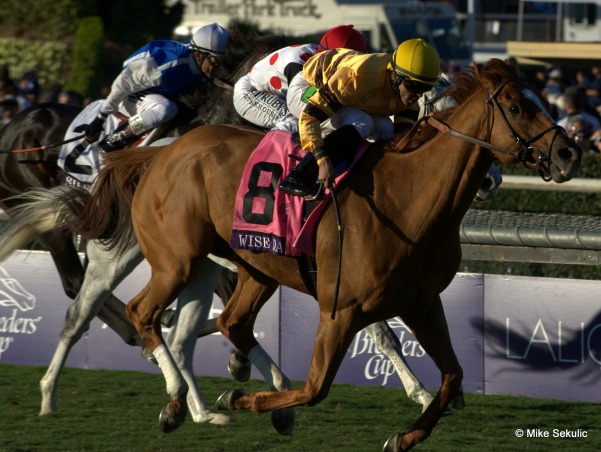 Wise Dan wins the Breeders Cup Mile 2013
A Quick Bit of History
People have been racing horses for thousands of years. The Greeks and Romans were into chariot races, and the sport has been a crowd-pleaser ever since. The modern version took shape in Britain in the 17th and 18th centuries, when breeders started mating horses specifically for speed.
That gave us the Thoroughbred. Every one of them traces back to three founding stallions: the Byerley Turk, the Godolphin Arabian and the Darley Arabian. Today, every Thoroughbred needs a documented pedigree and a passport (issued by outfits like Weatherbys) before it can race.
The Main Types of Race
Flat racing. No obstacles, just a straight-up test of speed on level ground. Races run from sprints of around five furlongs up to about two miles. You'll hear horses described as sprinters (fast over short trips), stayers (built for distance) or middle-distance types. Flat racing is on turf from late spring to autumn, and on All-Weather surfaces through the winter. These races are found worldwide, even in remote outposts such as Nepal.
National Hunt (jump racing). Here, horses jump hurdles or steeplechase fences, and races are usually longer, around two to four miles. Many jumpers are geldings, though other horses run too.
Harness racing. Big on TV in Europe, Australia and the USA, though less of a thing in the UK. The horses trot around the track pulling a driver in a little two-wheeled cart called a sulky, instead of carrying a jockey.
Endurance racing. The marathon of the horse world: anywhere from 5 to 150 miles over rough terrain, sometimes spread over a few days. One famous test is the Czech Velka Pardubicka, which is 4m 2f with more than 30 fences.
The Jargon, Decoded
- Age, weight and form. Younger horses can have the speed, while older ones often bring stamina and race smarts. Weight carried and recent results (form) matter too.
- Going. The state of the ground, from Heavy through Soft and Good to Firm. Some horses love a bog, others hate it, so check which ones.
- Draw (gate position). Where a horse starts on the flat can shape how its race plays out.
- Class and speed figures. Class (1 to 6) tells you how good the competition is, and speed figures give a sense of how a horse has been performing lately.
- Trainer and jockey. Good ones make a difference, so it's worth knowing who's in form.
Bookmaker vs Tote
You can bet in two ways. With a bookmaker, the odds are fixed when you place the bet (that's your "price"), and you know what you'll win up front. With the Tote, everyone's money goes into a pool, which is shared among the winners. The payout depends on how many people backed the same horse, so you don't know the return until the race is off.
Types of Bet
- Win. Your horse has to win. Simple.
- Each-way. Two bets in one: one on the horse to win, one on it to place (usually top 3 or 4, depending on the race). You'll pay double the stake.
- Ante-post. Betting well ahead of race day, often at juicier odds. The catch is that if your horse doesn't run, you usually lose your stake.
- Tote bets. Pool betting, as above.
- Forecast (the "exacta" in some countries). Pick the first and second in the right order. Harder, but pays more.
- Placepot. Find a placed horse in each leg of a series of races (typically the first six on the card). Winners share the pool.
How Betting Works, With Real Numbers
£5 to win at 4/1. If it wins, you get £20 profit plus your £5 back: £25 total. If not, you're down £5.
£10 each-way at 5/1, with 1/5 the odds for the top 3. That's £20 staked in total (£10 win, £10 place).
- Horse wins: the win bet pays £50 profit, and the place bet pays £10 profit (1/5 of 5/1 is 1/1). You get all stakes back too, so £80 returned.
- Horse places but doesn't win: only the place bet pays, so you get £20 back. That's just your stake, so you break even.
- Horse finishes out of the places: you lose the £20.
How to Place a Bet
- Pick a race. Start with one you can follow, not the whole card.
- Pick a horse. Read the racecard, check the form, and see how it handles the going.
- Choose your bet. Win and each-way are the friendliest to begin with.
- Check the odds. Look at a couple of bookmakers, because prices can differ.
- Place your bet. Choose your stake, confirm and watch the race.
Betting Examples
How Each Way Doubles Work
For example if we placed a £10 each way double on 2 horses in different races priced 3/1 at 1/5 the odds the return if both place is £25.60 giving a profit of £5.60.
If both win however the return is £185.60 and the profit is £165.60.
You can also place an each way double on two or more horses in the same race. But of course only one of them stands to win.
Obviously the each way double bet is worth serious consideration especially if we can find ourselves a bet where one of the odds is say 10/1.
Let's look at the return for a £10 bet where we have odds of 10/1 and 4/1. This would return £620 giving a profit (less stake of £20) of £600 if both won.
The Oddschecker bet calculator makes it easy to work out potential returns. To use the calculator CLICK HERE.
Reading a Racecard
The racecard lists each runner with its recent form (a string of finishing positions), age, weight, jockey, trainer and often the draw. Read the form figures from right to left: the most recent run is on the right. Learn what the key columns tell you and you're halfway to making an informed pick.
Three Beginner Mistakes to Avoid
- Backing a horse because you like the name. Fun, but not a strategy.
- Ignoring the going. A horse that loves firm ground can look awful in the mud.
- Chasing losses. Set your stake before you start and stick to it.
Beginner FAQs
What does each-way mean? It's two bets, a win and a place, for double the stake.
What is the Tote? A pool betting system where winners share the pot.
How do odds work? 4/1 means you win £4 for every £1 staked, plus your stake back.
What's the going? The condition of the ground, from Heavy to Firm.
What's an ante-post bet? A bet placed well ahead of the race, usually with a risk if the horse doesn't run.
Do I need to pay attention to the trainer and jockey? It helps. Look at who's in form.
Final Thoughts On Betting on the Horses A Guide For Beginners
Horse racing mixes excitement, strategy and a bit of luck. Learn the types of race, get comfortable with the terms, and do your homework before each bet, and you'll enjoy it a lot more. Have fun, and bet sensibly.
Recent Articles


-
The Lucky 15 Bet: A Popular Multiple Bet Strategy
Oct 13, 26 04:17 AM
 The Lucky 15 Bet: A popular multiple bet strategy that can pay out even if only one selection wins, consisting of 15 different combinations
 -
Greyhound Racing Locations For Stadia Throughout The UK
Oct 13, 26 03:46 AM
 Finding greyhound racing locations around the UK is quick and easy with this guide to dog tracks around the country
 -
Top American Racing Picks And Horse Racing Information In The U.S.
Oct 13, 26 03:36 AM
 Learn about American racing and follow our own racing picks through the Graded Stakes races to the Breeders' Cup