Paddy Power 100 Shop Closures
The Paddy Power 100 shop closures are set to damage the UK horse racing industry further.
 Paddy Power 100 Shop Closures
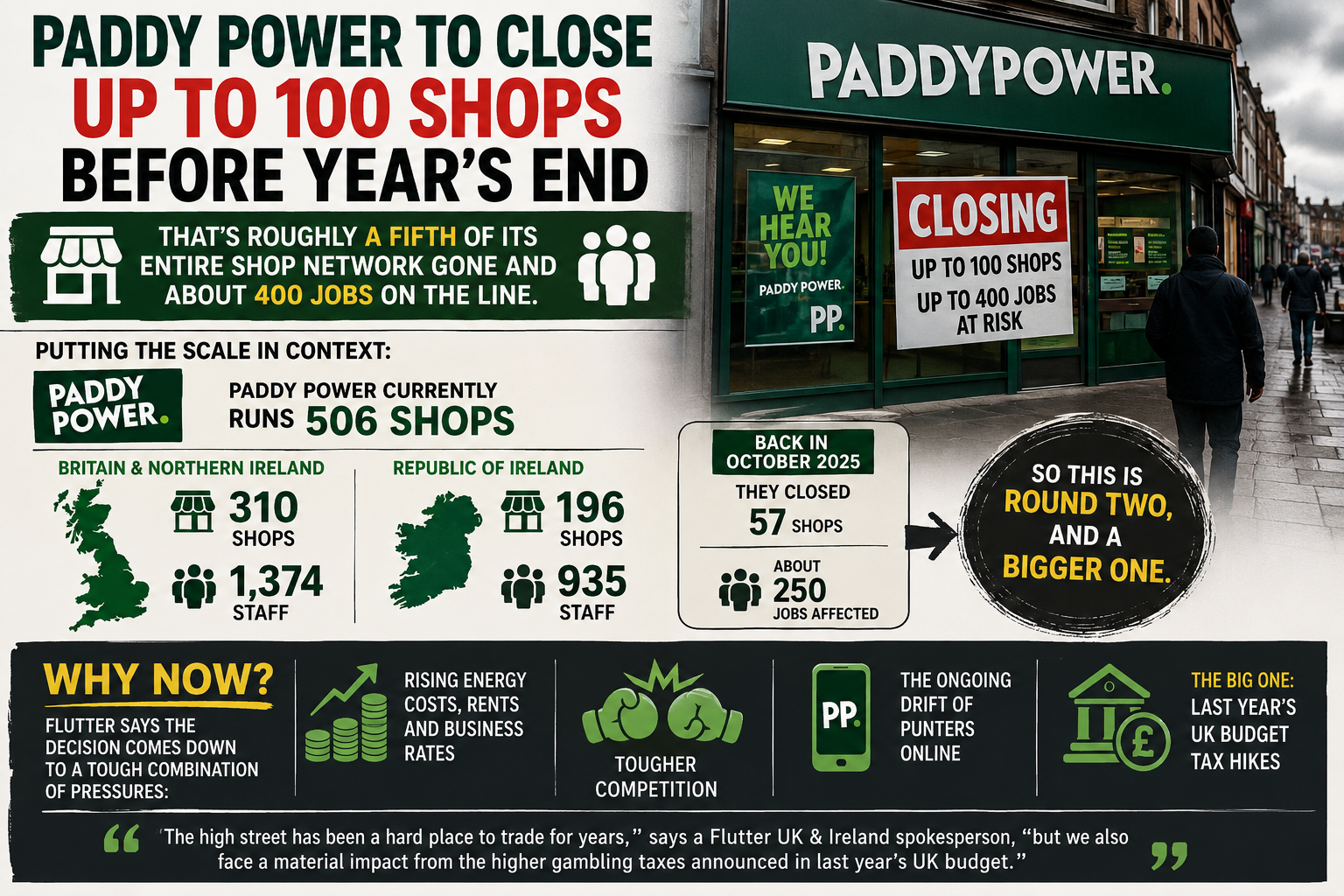
Here we go again. Paddy Power has just confirmed it's reviewing its UK and Ireland retail estate with a view to closing up to 100 betting shops before the year's out — that's roughly a fifth of its entire shop network gone, and about 400 jobs on the line. Parent company Flutter says it'll try to redeploy staff where it can, but this is still a grim one for the high street.
To put the scale in context: Paddy Power currently runs 506 shops — 310 across Britain and Northern Ireland (1,374 staff) and 196 in the Republic (935 staff). Back in October 2025, they closed 57 shops, affecting about 250 jobs. So this is round two, and a bigger one.
Why now?
Flutter's line is the now-familiar combination of rising energy costs, rents and business rates, tougher competition, the ongoing drift of punters online — and, the big one, last year's UK Budget tax hikes. A Flutter UK and Ireland spokesperson put it like this: the high street has been a hard place to trade for years, but "we also face a material impact from the higher gambling taxes announced in last year's UK budget."
There's a bit more colour behind that. Remote Gaming Duty — the tax on online casino-style games — nearly doubled under former chancellor Rachel Reeves, jumping from 21% up towards 40% from April 2026, with Flutter estimating a knock to 2026 earnings in the region of $320m before mitigation.
Analysts reckon these shop closures are essentially part of that mitigation strategy — trimming the underperforming physical estate to offset the tax pain elsewhere. Goodbody analyst David Brohan reckons it won't be the last round either, especially as leases expire and if machine games duty (MGD) goes up too.
It's also worth noting Flutter's just had a rough set of Q2 results — swinging from a $37m profit to a $296m loss year-on-year — and there's a leadership change afoot, with CEO Peter Jackson stepping down in favour of Dan Taylor, currently head of Flutter International.
Despite all that, Jackson's been talking up Flutter's plan to grow UK market share as smaller rivals get squeezed by the same tax environment — "we're going to keep our foot down hard on the marketing and generosity side," as he put it.
 Virtual Horse Racing
Racing's the one picking up the bill for the Paddy Power 100 Shop Closures
This is where the Paddy Power 100 shop closures get painful for British racing. The sport leans heavily on betting shop income — consultants Regulus Partners reckon around 40% of racing's income still comes via bookmakers' shops, through the levy and media rights payments. Every shop that shuts is direct money lost.
When Betfred announced 132 closures back in July, the estimated hit to racing was put at around £4 million in lost levy and media rights payments. Betfred separately reckons each shop contributes something like £30,000 a year to racing through these payments — so do the maths on 100 more shops and it's not small change.
The Betting and Gaming Council estimates betting shops contribute somewhere around £140 million a year to British racing in total, which gives you a sense of just how much is potentially exposed if the closures keep coming.
BGC chief executive Grainne Hurst has been out warning policymakers this week that the financial relationship between racing and the high street bookmakers is becoming increasingly strained — and that further closures risk pushing punters toward unlicensed, offshore operators who pay nothing back into British racing at all. That's a point racing bodies keep making and politicians keep seeming to ignore.
Not every operator pays the same either — Greg Knight, boss of independent chain Jenningsbet, said the cost of showing racing in his shops had shot up nearly 75% in five years, from £40,000 to almost £70,000 per shop including VAT. So the economics of actually broadcasting racing in a betting shop are getting worse even before you factor in closures.
Arena Racing Company chief exec Martin Cruddace didn't hold back at a parliamentary reception recently, warning that further tax rises on betting shops could be "truly grave" for racing and that the sport "cannot be collateral damage" in a wider crackdown on gambling.
The political backdrop
This is all landing at an awkward moment politically. New prime minister Andy Burnham has been notably hostile to betting shops, telling the Commons the government's taking "tougher action" on vape shops, adult gaming centres and "other gambling venues" — and has previously described betting shops as "dodgy businesses."
He also wants to hand councils more power to block new shops from opening. Racing industry figures argue this narrative doesn't really hold up — shops have been closing in the hundreds for a year now, hardly a "proliferation."
Adding to the pressure, former PM Gordon Brown has called for a big increase in machine games duty, echoing a proposal from the Social Market Foundation think tank. If MGD does go up, expect even more shops to become unviable — which loops straight back into more lost income for racing.
The bigger picture
Since last year's Budget, the toll across the industry has been brutal:
- Evoke (William Hill): 270 shops closed following a strategic review (some reports put the confirmed figure at 230)
- Betfred: 132 shops
- Entain (Ladbrokes/Coral): closing around a third of its Irish Ladbrokes shops, and estimated as many as 560 shops closed industry-wide since the Budget
- Paddy Power: 57 shops last October, now up to 100 more
That's getting on for a thousand shops gone or going in under a year. Whatever you think about the merits of higher gambling taxation, it's hard to argue betting shops are "proliferating" on Britain's high streets right now — if anything, the opposite is happening fast, and racing is caught in the crossfire of a crackdown that was really aimed at things like adult gaming centres.
The uncomfortable truth for racing is that this isn't a one-off shock to absorb — it's a structural shift. Media rights negotiations between racing and the bookmakers are only going to get tougher as the shop estate shrinks and the economics get worse for whoever's left. Racing's going to have to find new income streams, and fast, because the traditional bookmaker-funded model looks like it's shrinking for good.
The Popular Daily Lay Tips UK/IRE £5 per month
Subscribe Below
Horses To Follow list is constantly updated
Subscribe Now for just £5 per month
Subscribe Below
French Lay Racing Tips for £10 per month
(Money back guarantee if you don't make a profit in the first month)
Subscribe below
You might like these
Betfred Free Bet Offers: A Comprehensive Guide
Betfred free bet offers an extensive range of betting and gaming options that go far beyond conventional sports betting
Ladbrokes Christmas Free Bet Comes Round Once A Year
Ladbrokes Christmas free bet goes some way to bringing a little seasonal cheer
Horseracing Betting Online Continues To Benefit Punters
Horseracing betting continues to evolve and improve the punters's experience

Your second block of text...

Returns Policy: Once a customer has agreed to pay for a product or service no returns will be permitted or payments returned.
All PayPal transactions are subject to the PayPal Privacy Policy
Privacy Policy: Personal details provided to this site by an individual may be shared with third parties unless requested otherwise.
Above policies updated 15 March 2018
Recent Articles


-
The Lucky 15 Bet: A Popular Multiple Bet Strategy
Sep 15, 26 04:12 AM
 The Lucky 15 Bet: A popular multiple bet strategy that can pay out even if only one selection wins, consisting of 15 different combinations
 -
Greyhound Racing Locations For Stadia Throughout The UK
Sep 15, 26 03:59 AM
 Finding greyhound racing locations around the UK is quick and easy with this guide to dog tracks around the country
 -
Top American Racing Picks And Horse Racing Information In The U.S.
Sep 15, 26 03:19 AM
 Learn about American racing and follow our own racing picks through the Graded Stakes races to the Breeders' Cup